Spring 2026
Quiz 1
- estimated error (uncertainty) in graduated cylinder measurement (reference Error Analysis Review)
- 1.0 ml of distilled water (density = 0.997) was pipetted 10 times and weighted on a calibrated Mettler-Toledo XSR105 balance (+/- 0.01 mg). This data was recorded and saved as an ascii (csv) file on the CHM343 GitHub Data repository: 2024_08_24_Weight_1ml_Water_Pipette_Data.txt. What is the uncertainty (one standard deviation) of this pipette in delivering 1 ml of water?
- Propagation of error in density from measured mass and volume (reference Error Analysis Review)
- An experimental measurement of the rate constant from temperatures between 300-350 K have been recorded and saved as an ascii (csv) file on the CHM343 GitHub Data repository: Temp_Rate_Constant_kerr_Example_Data_CHM343.txt. Use nonlinear least-squared curve fitting of the data to determine the activation energy.
- A recent paper in the Journal of Chemical Education (2026) was published entitled: “Spectrometer Assembly and Python-Based Data Science Lab on the Reduction Kinetics of Methylene Blue”. Do a literature search and obtain this paper and all the associated supporting information. Reproduced figure 6c and determine the associated pseudo-first-order rate constant (kexp) and report the value below in units of min-1.
Quiz 2
- Which is the appropriate thermodynamic condition for the propagation of sound in a gas? isothermal, isobaric, isenthalpic, or adiabatic (students should be able to justify/explain their answer)
- If the length of a closed acoustic interferometer tube (Kundt tube) is L, what is the wavelength of the lowest frequency resonance mode?
- The 4 most commonly used modern refrigerant gases are difluromethane (R32), 1,1-difluoroethane (R152a), 1,1,1,2-tetrafluoroethane (R134a), and 2,3,3,3-tetrafluoropropene (R1234yf). Which of these molecular gases has the greatest vibrational contribution to its heat capacity at standard temperature and pressure (STP)? Note: Students should do standard optimization and vibrational computational chemistry on each of these molecular gases using an electronic structure computational package (i.e., molcalc.org, RowanSci.com, chemcompute.org, ORCA, Psi4, or Gaussian)
- In the case of oxygen and ethane gas, they have very similar mass and sound velocities, so the effect of heat capacity is the dominant distinguishing factor. What molecular degree of freedom most contributes to the decrease in the speed of sound of ethane gas compared to oxygen gas? (and hence the increase in the heat capacity of ethane gas compared to oxygen gas at standard temperature and pressure, STP). Students should do standard optimization and thermodynamic computational chemistry on each of these molecular gases using an electronic structure computational package (i.e., molcalc.org, RowanSci.com, chemcompute.org, ORCA, Psi4, or Gaussian)
- The speed of sound of various gases is experimentally measured using an acoustic interferometer. In order to use an acoustic interferometer to obtain accurate experimental measurements of a gases sound velocity, it is critical to have an accurate and precise determination of the length (L) of the acoustic interferometer tube. Measuring the length with a ruler, for example, does not provide an accurate enough determination of the tube length. What is commonly done is to start with a gas that has a known sound velocity and use it to calibrate and/or measure the length of the acoustic interferometer tube to a high accuracy. Argon gas is most commonly used, and has a known sound velocity of 320.0 m/s at 23C. Use the following experimental data uploaded to GitHub (Argon_Gas_acoustic2_pchem_dev_WN_22kHz_100vol_SensorsData.csv) to determine an accurate acoustic interferometer tube length for the acoustic2.pchem.dev system.
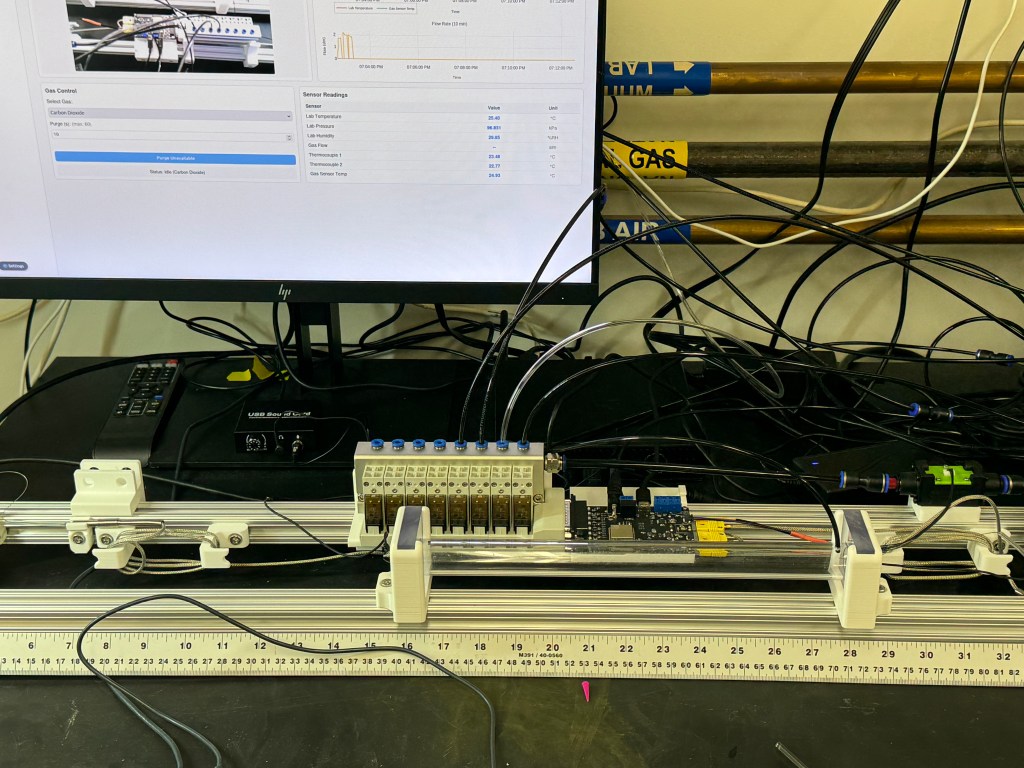
The image of the components for a remote acoustic interferometer (acoustic2.pchem.dev) are shown along with a ruler next to the polycarbonate tube. This visually shows that the tube is roughly 1 foot. Above the polycarbonate tube with end caps is the gas valves and the microcontroller.
Quiz 3
- Information updated the week of April 6, 2026.
Quiz 4
- Information updated the week of April 20, 2026.
 BioPchem